



Insights
Connected Is Not the Same as Clever
A City Full of Sensors Isn't a Smart City. It's Just a City With a Lot of Sensors.
Naveed A. Pirzada·Chief Operating Officer·

Plenty of cities have the gadgets. The clever bit is getting them to talk to each other.
Somewhere in a city you could name, there's a traffic system that knows exactly how bad the roads are. Down the corridor, a transport team has a separate system that knows exactly how full the buses are. In another building, someone has a dashboard showing how much energy the town hall is burning through.
Three systems, three teams, three screens. And not one of them has any idea the others exist.
That's the quiet scandal of the smart city era. For twenty years we've been installing sensors, platforms and control systems at a heroic pace, and plenty of cities are now very well equipped. But being well equipped and being intelligent are not the same thing, and the gap between the two is where the real work starts.
Lots of data, very little insight
Cities produce a staggering amount of information. Roads report on traffic. Buildings report on energy. Environmental monitors report on air quality, and every municipal service keeps its own records.
Taken together, that data could tell you how a city actually behaves. In practice it's locked away in departmental silos, written in incompatible formats, owned by different teams who each have their own rules about who gets to look. Add some legacy kit that can't talk to anything made after 2010, and you've got decision-makers who are drowning in information and still can't see the big picture.
The problem was never a shortage of data. It's that nobody can use the data they've already got.
Make the old systems talk before you buy new ones
The fix has an unglamorous name: interoperability. It simply means different systems being able to swap information and make sense of it.
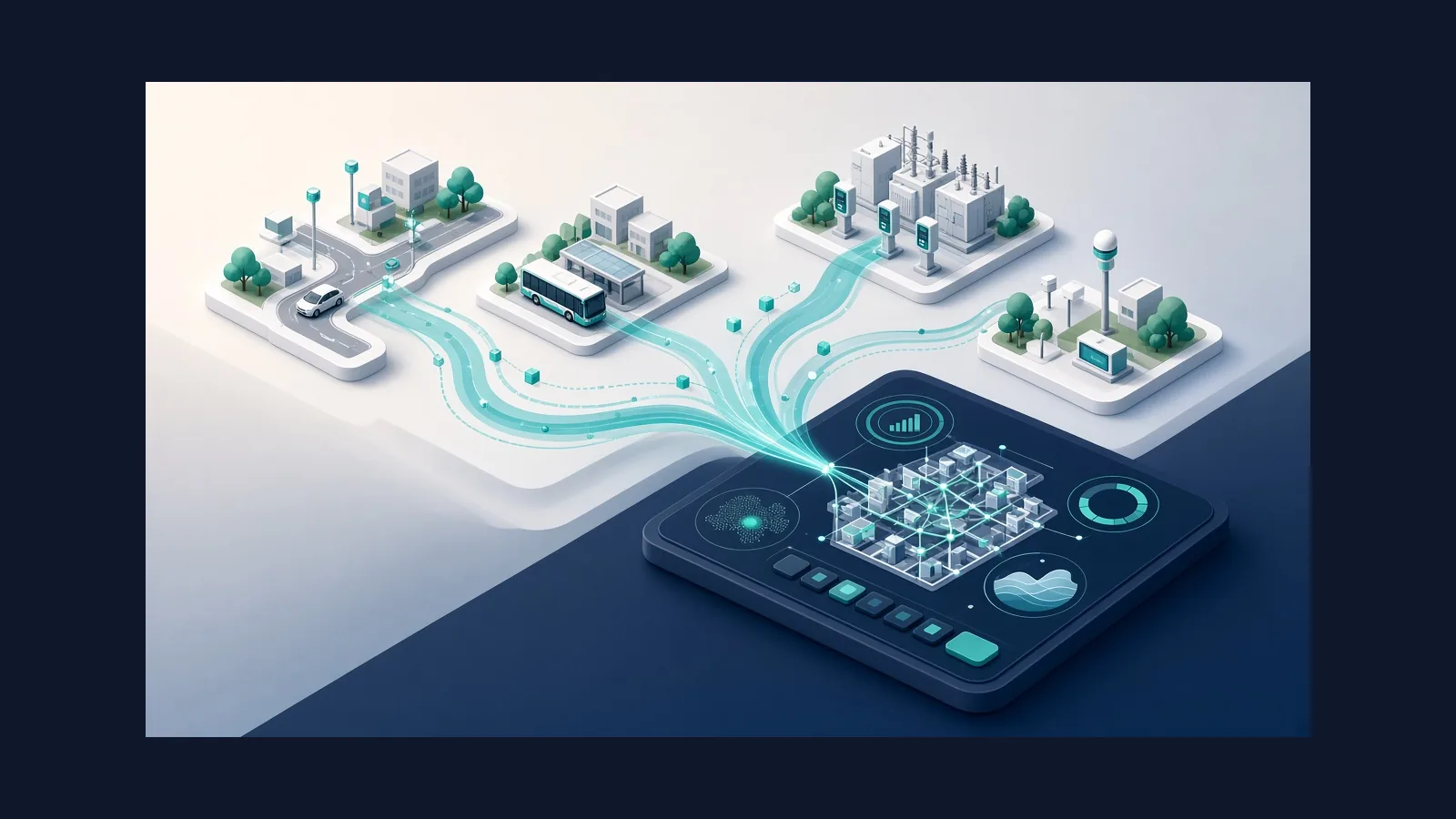
Think about what happens when traffic, buses, parking and air quality can finally be looked at side by side. Suddenly you can see how congestion lines up with bus demand. You can see which roads are being worn down fastest and plan repairs before the potholes arrive. You can check whether a building's energy use actually matches how many people are inside it.
None of that needs a giant new platform that swallows everything else. Usually the smarter move is more modest: connect what you already have, agree on common data standards, decide who's responsible for what, and be clear about the problem you're trying to solve. It's less like building a new house and more like finally putting doors between the rooms.
AI is useful, but it isn't magic
Most digital systems are good at telling you what already happened. AI's trick is looking ahead: spotting patterns, predicting what's likely to break, flagging the odd reading before it turns into a real headache. For a city, that could mean fixing a pump before it fails, or staffing for a busy day before the queue forms.
But it comes with a catch that's easy to forget in the excitement. AI is only as good as what it's fed. Give it patchy, fragmented or unreliable data and it will give you confident-sounding nonsense. Security, privacy, transparency and a human who can say "that doesn't look right" all matter just as much as the algorithm.
Intelligence isn't something you install. It shows up when good information, the right tools and sensible people are all pulling in the same direction.
Residents don't care about your IoT strategy
Smart city talk gets jargony fast. Interoperability, predictive analytics, digital twins, the Internet of Things. All fine, all useful, and all completely invisible to the person trying to get to work.
What people notice is whether the commute got shorter. Whether the bus turned up. Whether the council fixed the thing they reported, and whether the park feels safe and the office isn't freezing. If the technology is doing its job, residents never think about it at all. They just notice life is a bit smoother.
That's the test. A traffic system earns its keep if journeys improve. An energy platform earns its keep if buildings waste less. An analytics tool earns its keep if public money goes where it's needed. The tech is the means. The better day is the point.
Why great ideas still get stuck
If all this is so sensible, why isn't every city doing it? Because someone has to pay for it, and the maths is awkward.
New technology means upfront cost, awkward integration with older systems, specialist skills and maintenance that never really ends. Even when the benefits are obvious, they're often spread across several departments or arrive slowly, which makes the business case hard to write and harder to defend.
That's why this can't be treated as purely a technology project. It needs a commercial plan, a funding model that fits and a realistic view of who will build, run and maintain it all.
This is where Valo Smart City comes in. Its approach starts from the idea that technological capability and financial enablement have to be planned together, so that promising infrastructure ideas have the commercial and operational footing to actually get delivered. For governments and developers, that means judging technology as part of a wider plan for how assets perform and last, not as a one-off purchase.
What the winners will do differently
The cities that come out ahead won't be the ones with the most sensors or the biggest dashboards. They'll be the ones that make smarter use of what they already have.
That means moving from isolated systems to connected ones. From firefighting to spotting trouble early. From "look what this gadget can do" to "here's the problem we're solving." And from clever pilots to projects with a funding model that survives contact with a budget committee.
Spending the most won't decide who gets there first. Knowing where technology genuinely makes a difference, wiring it in properly and keeping it going for the long haul will.
The real promise of an intelligent city was never that everything is connected. It's that everything finally works together.